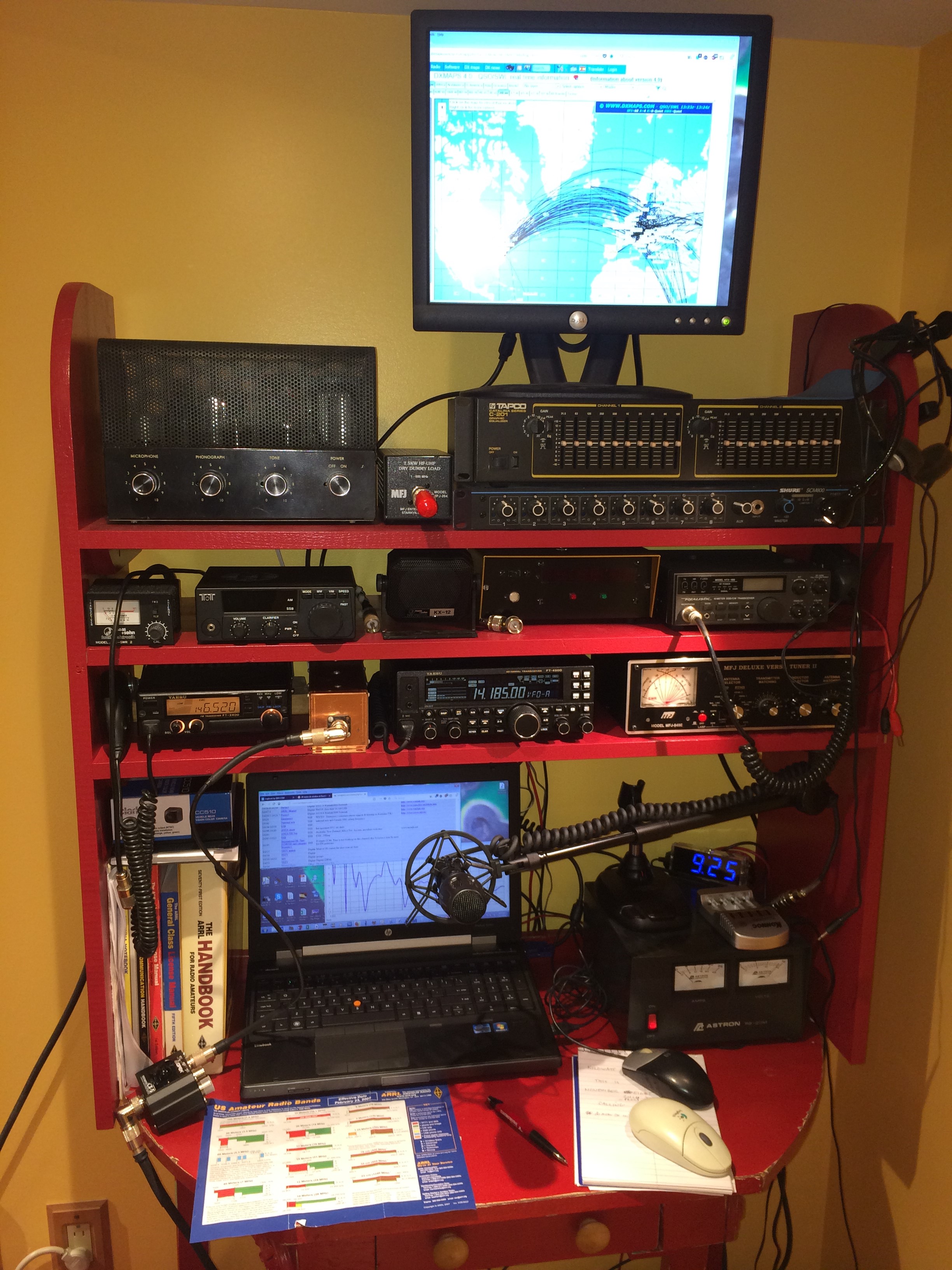
Amateur radio is a strong interest of mine and I read a lot on topics of antennas, propagation, and especially the history of radio. I’ve had my FCC license since the early 90’s and my Extra Class was earned sometime around 2007. Despite that, I only managed to put together a “real” HF station in the last year or two. Partly it was space, and partly it was time. I had neither. But a couple of years ago we built a new guest bedroom with an egress window, which gave me the place, and more recently, stepping away from playing out monthly with Rocket 8 gave me the time, almost. I still don’t get much time to hunt for DX contacts, but it’s there when I do get the time, and I’m making slow and steady progress on the station itself. I’m currently able to communicate on the 80m, 40m, 20m, 15m, 10m and 2m bands. My main radio is a Yaesu FT-450D for the HF-6m range and my old trusty Yaesu FT2400 for 2 meter. I have a multi-band Alpha-Delta DXCC up over the house configured as a straight dipole at around 33 feet or so. I also have a Comet 2m 5/8 wave vertical with a radial kit on a small mast up around 22 feet. My grounding system is pretty good, three 8′ rods spaced about 16′ apart, and they are connected via 2″ copper band (18 ga?) to a couple of large lightning arrestors mounted to an IP-sealed box down in the covered egress window well, which sits atop a 1″ hole through the concrete wall that I drilled before the bedroom was finished. It’s a nice setup but it still needs a few things. In particular I want to get a 6m dipole up soon, I have the cables and ropes in place from a previous 10m dipole install, I just need to get some time to make it happen. I repurposed an old table by building a matching shelf system designed to hold the radios I have and still have some space for the laptop.
The station setup includes the 2 aforementioned Yaesu radios, plus an MFJ tuner, an Astron power supply (I really want solar for this station, ASAP), a TenTec HF kit receiver, an oddball SWR meter for 2m antenna, an old drake High Pass filter for the 450D and my newest investment, and a RigExpert portable analyzer that works to 600MHz. The RigExpert is best when used with the PC, so you can do very detailed SWR sweeps across the whole HF spectrum to keep track of the multiband Dipole. This past summer it was reading a little shallow across several bands at once, which led to a rooftop inspection. Sure enough, several crimped connections had worked their way loose and had to be reworked, cleaned and this time, soldered. (Alpha Delta didn’t solder them.) The Rig Expert is a really nice machine and worth the cost. My next step inside will probably be an SDRPlay receiver, which will allow real-time spectrum analysis across all bands, so openings will be easy to identify. On the Wish List, I’d like to investigate the 70cm digital repeater we have here in Holland, but that radio investment is on the back burner for now. In the picture you can see the equipment mentioned above, including a recent plot of the whole HF spectrum with the SWR dips at resonance on the laptop screen. The extra screen up above is showing a real-time graph of communication between North America and Europe at the time the picture was taken. Each curved line is a conversation that was logged within the last 15 minutes. You can click on them to see the details of the people talking. Cool stuff!
Update, Dec 2022:
I have been more active in the last couple of years on HF. In the last several years, I’ve repaired a few high-wattage linear RF amplifiers for MTA customers, which only piqued my interest in getting one in the station for myself. An opportunity came as a tube amp customer contacted me regarding his father’s ham shack gear. His father had recently entered a nursing home and some gear needed a new home. From him, a 90’s Kenwood TS-570 HF transceiver, an Ameritron 811H amplifier, a high-power MFJ tuner plus an Astron 35M power supply were received as a package deal for a very fair price.
While all were reported to be in operable shape, the reality was, they were not. But clean, complete and repairable, they were. The amp did not produce power as it should have, and clearly some repairs around the metering were needed. In the end, the main issue was a loose ground in a hard-to-get-to place on the back-plane PCB near the input tuning slugs – a loose screw bonding the pcb to ground was all it took to ruin the input coupling. All that now sorted, it makes rated power and I have enjoyed learning to use it. RF amplifiers are much trickier beasts than audio amplifiers, due to the need for maintaining resonance at the operating frequency, coupled with the ease of blowing up rather expen$ive tubes with arc-over or melted plates if you are not paying attention. The tuner needed a lot of love as well, needing the contacts cleaned, roller inductor serviced and some solder points touched up before it would behave itself. The radio worked well for a while but started losing it’s memory. Digging into it and replacing the backup battery was remarkably easy due to solid engineering by Kenwood. I have really come to love this radio, very very intuitive to use and a great feature set. The Astron needed a number of transistors and some diodes, but has proven reliable over many hours of use now.
I have also developed the solar station I wanted to have in the last 2 years. Two folding panels (200w advertised, actual being slightly less), a charge controller, a large battery, along with two small pelican-style cases housing the Yaesu radio, a small tuner and a 130′ end-fed half wave antenna. It works very well. I can put out a 100w signal on HF just about anywhere the sun shines. My daughter and I deployed it to a local park a while back. It took about 2 hours to arrive, set up the gear, throw the antenna up into a tree, tune up, make several contacts around the southeast states, and pack it all in again. It’s been deployed repeatedly on a couple of camping trips, including within a 3 week swing of the Dakotas and Devil’s tower. Goal attained. I have now bought a large lifting kite to fly the antenna with, eliminating the tree requirement, but that system is still under development. The type of kite I got requires a pretty steady wind of about 8-10 MPH, and keeping it aloft on a stormless day has proven a challenge on the few days I have had free to try it in 2022. It will work, but it needs some tweaking – maybe even a different style of kite that needs less wind.

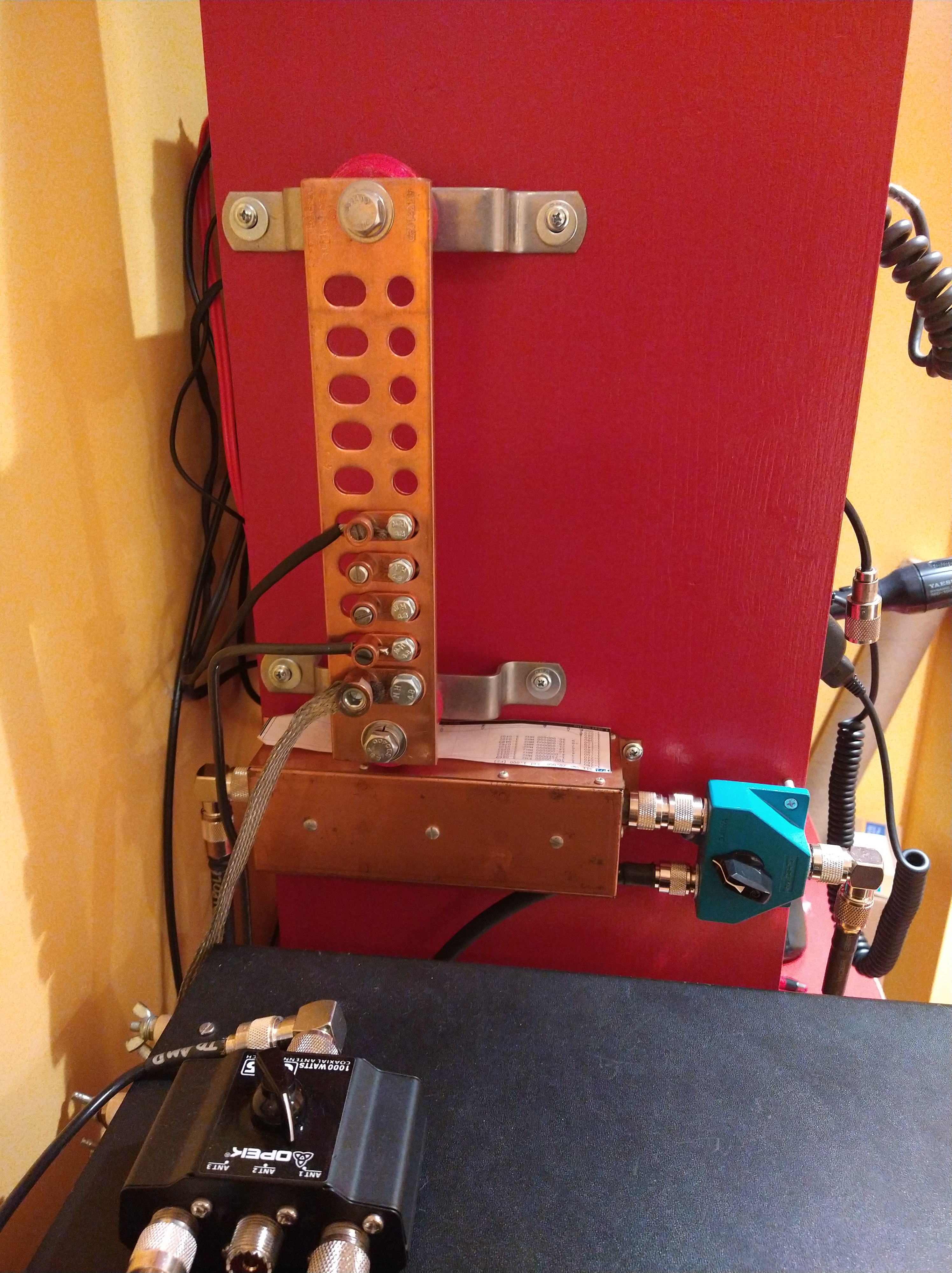
The station grounding outside is very good, but the desk ground needed a bus-bar update before a linear would be safe to run. Also, added some switching for the 1kW dummy load – making tuning up safe and convenient. The copper box at the bottom is a quality vintage low-pass harmonic filter that was ran over a net an before being installed.
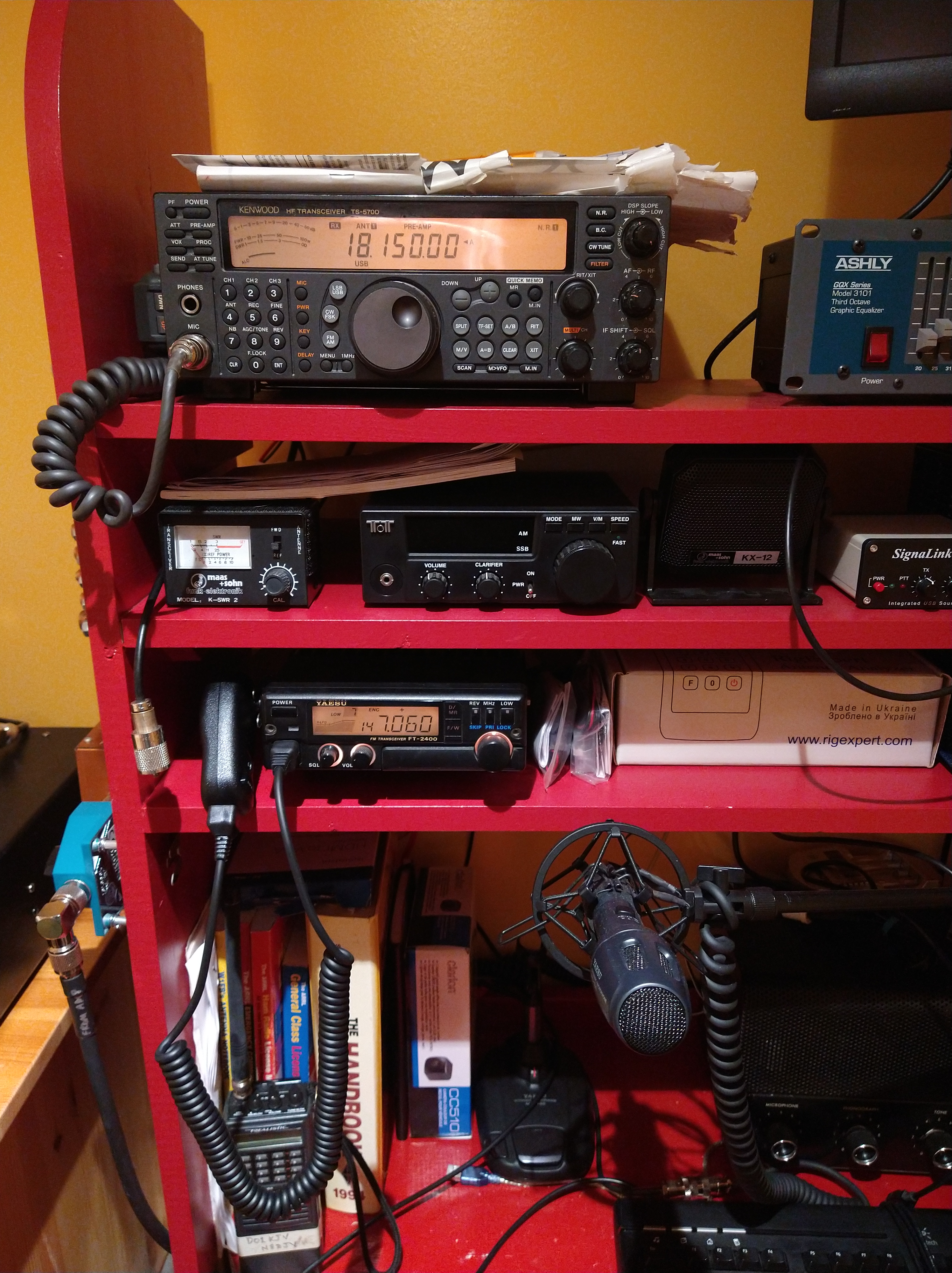
New (to me) Kenwood HF radio (top left ) is a hit- I prefer it over the Yaesu due to the layout and controls.

The updated solar portable radio station, deployed at Ludington State Park on the Lake Michigan shore, summer of ’22.

This is the diagram I used so my daughter and I could quickly see what goes where. SAE and Anderson connectors were used. The solar panels (Blue Sky brand) charge controller and pre-made cables were all sourced from Amazon. The SAE connectors are compatible with camper solar input connectors. This proved useful in the Dakotas when my parents inadvertently killed their camper battery due to a storage space lamp being left on.
The radio and tuner are in pelican-style cases, the rest fits into a waterproof tote. The battery and charge controllers are mounted in standard battery boxes with up-rated cargo straps to keep them shut during handling. As far as durability & transport goes, my only concern is the glass of the solar panels. Maybe I will get lucky and find something stronger than the semi-rigid zip-covers they came with. Those and the original shipping boxes are all I have protecting them right now.
Update Jan 6, 2026
One big improvement in the portable system is a high-current DC-DC converter… The BMS of my 100A/H LiFePo4 battery did not like the current spikes that SSB radio can consume. It would let the voltage sag to a point that would just occasionally reset the Yaesu radio. (11.8-12v) Annoying. The DC-DC converter will keep the voltage up where it needs to be, at 13.8V. So far it has worked out. On-air tests with and without it in RX mode show that it does not add to the noise floor on any band I can use with this EFHW antenna. (Surprising, I KNOW!) I did apply a lot of filtering – a dedicated filter, then more coils, fast poly caps and several ferrites – to the package before I even attempted to use it on HF. I can use the full 100w of the radio now without reset, 100% of the time.
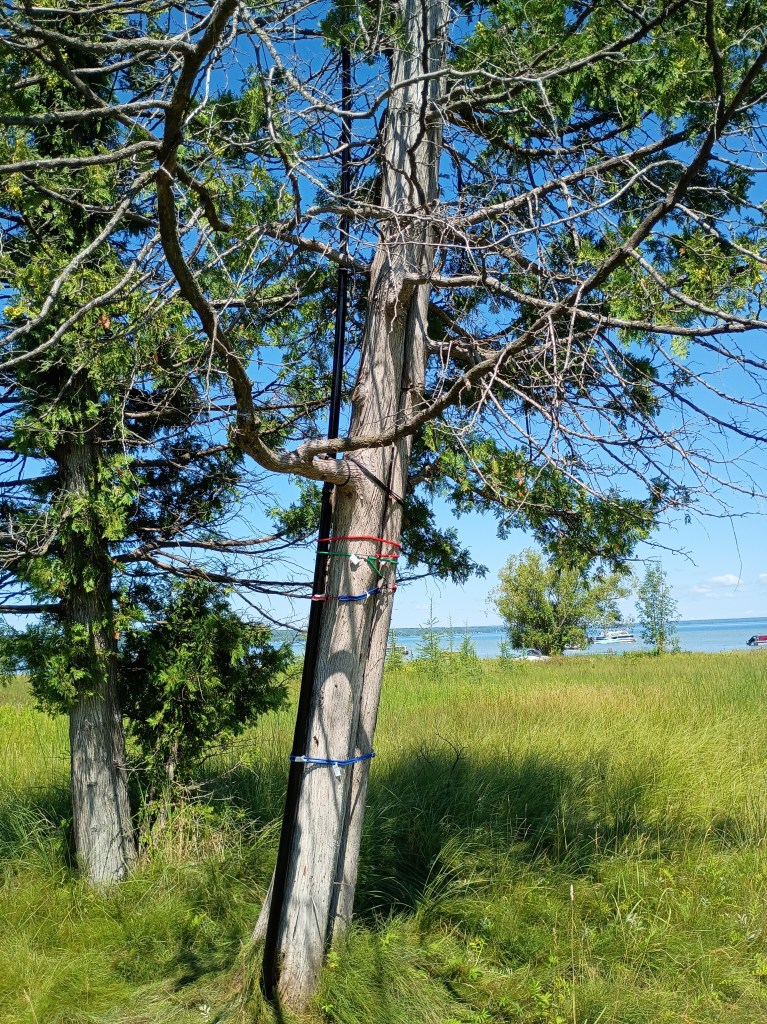
I think I should also mention last year’s purchase and deployment of a 45-foot fiberglass mast to the Portable Solar Radio Kit. I got it from a nearby ham operator who no longer had a need for it, and the price was agreeable. It is a game-changer for deploying the far end of a 132′ EFHW antenna up in the clear, and so long as you have something robust to tie it to, it can be put up without guy wires if you don’t use the top section. It is rather thin in the last section, and I didn’t think it wise to put that much curve/side load on it.
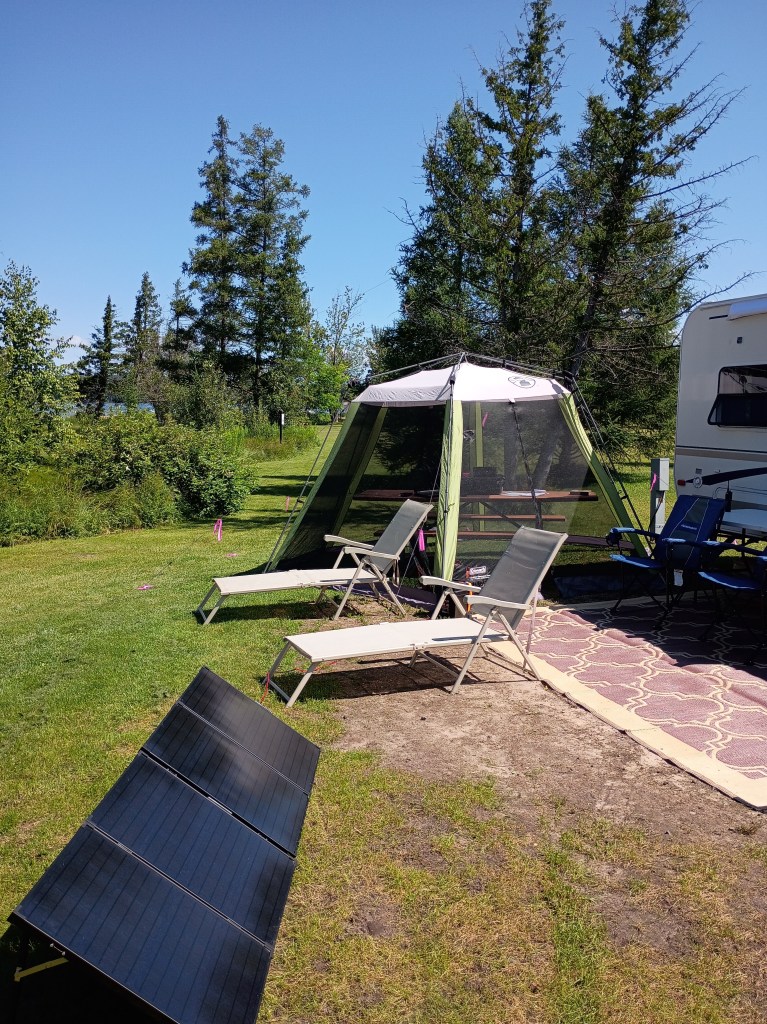
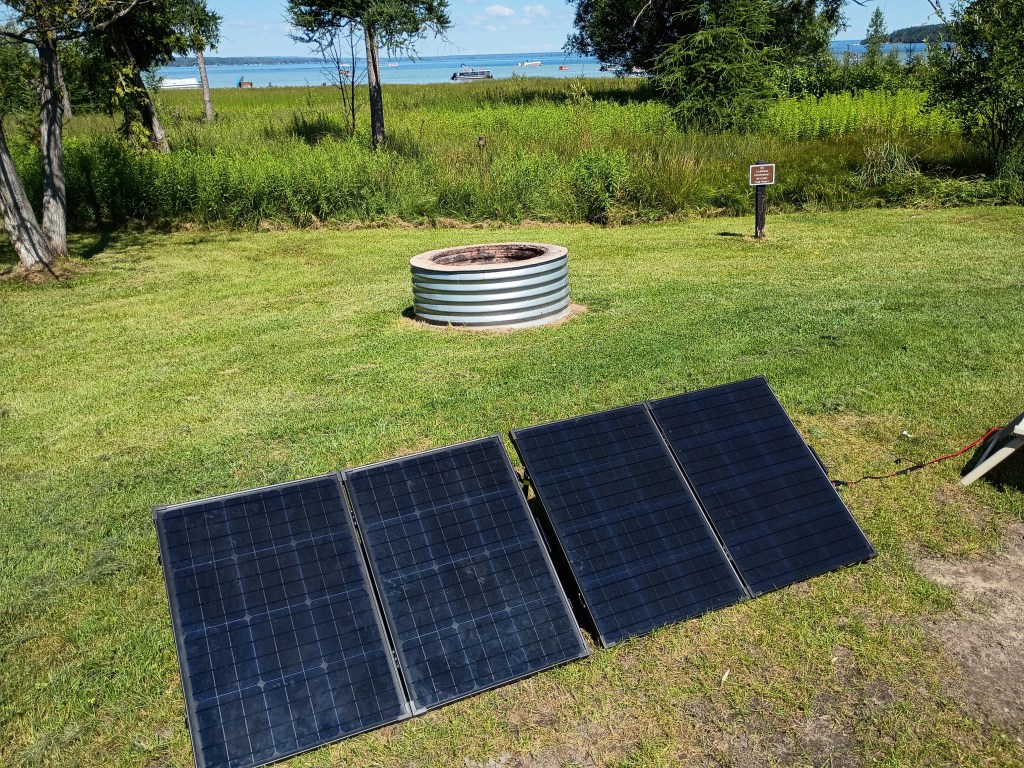
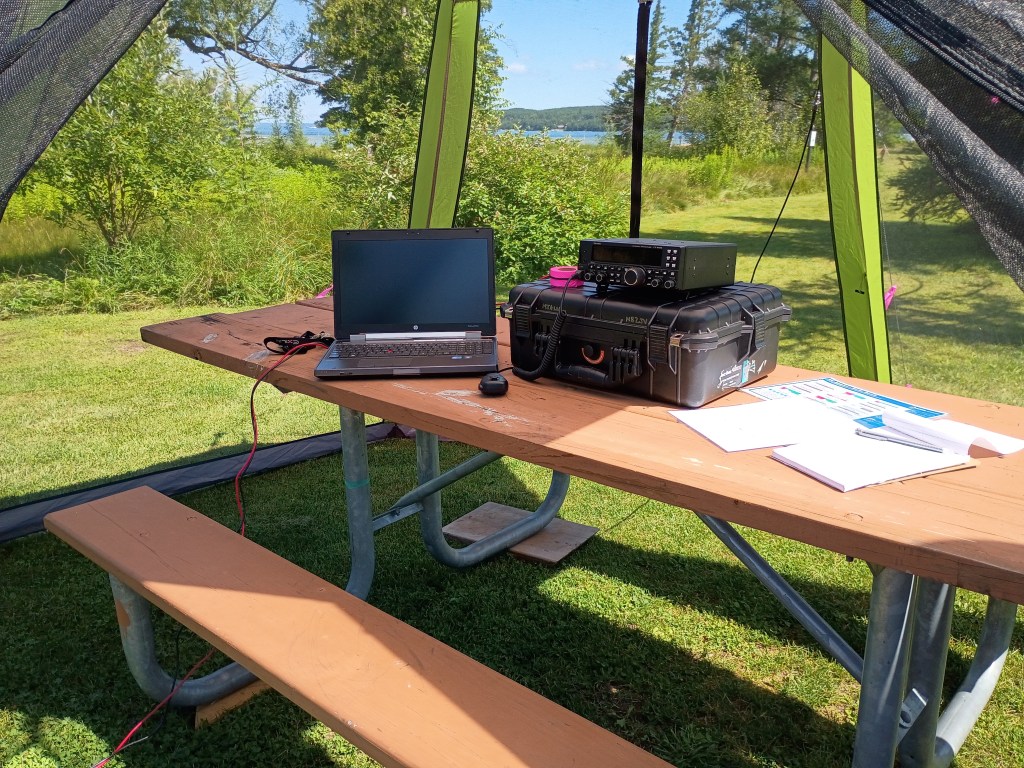
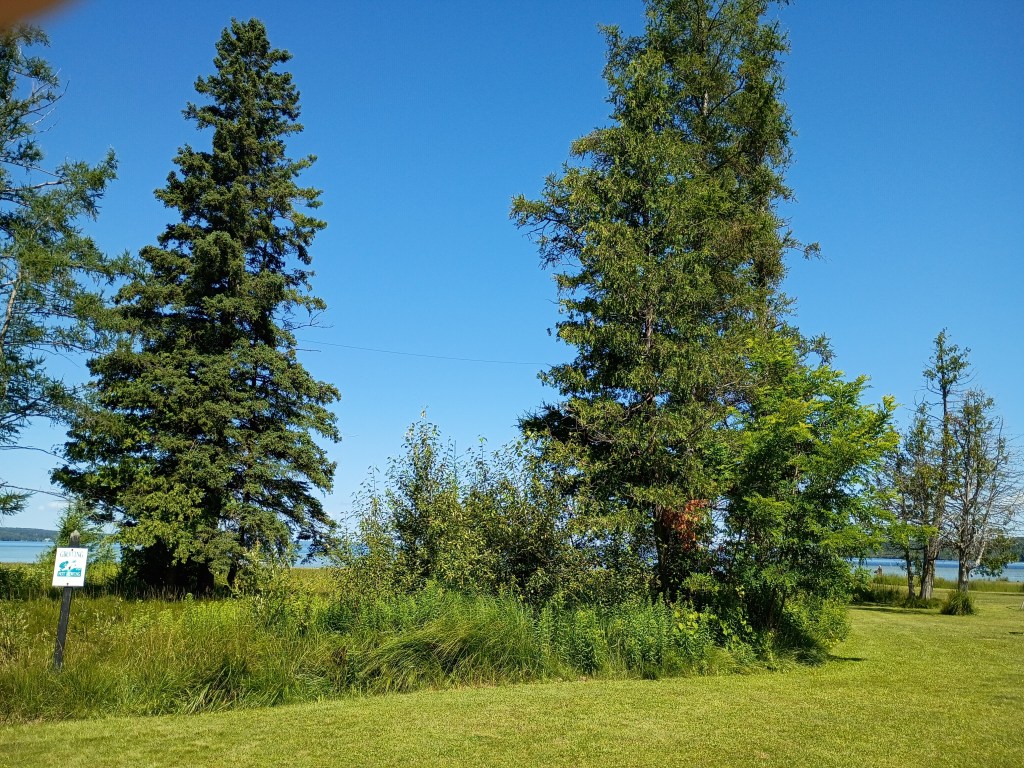
As my own family were in Germany for most of the 2025 summer, I invited my sister along on a brief camping trip. We booked several days up at Burt Lake State park in northern Michigan. She had literally not been camping since she was in her teens. The weather cooperated for the whole stay and I even got her help getting everything up. It was a pleasure to see her enjoy being outdoors. It was a big plus, that we had very little going on for insects that week up there. It was also very convenient not to have to battle the slingshot gods to get a decent place to hang the end of the EFHW wire. Per my usual practice, I coordinated with the main park Ranger before I set anything up. They came out and took a look at what I was proposing, agreed to it and came back to inspect my work later when it was up. No trouble at all and they really appreciated the “asking first” part. It was a lakeside lot by choice, with a wide open area to the North of our campsite, facing the water. There were just a few trees, one of which was perfect for lashing the mast to with a number of bungee cords. Quick install, quick breakdown. Here are a few pictures from the 2025 campsite at the lakeside…



 While You Wait Amp Repair At MyTubeAudio LLC.